Reviews in the History of Stuff #4

51iqBpPWXEL._SX316_BO1,204,203,200_

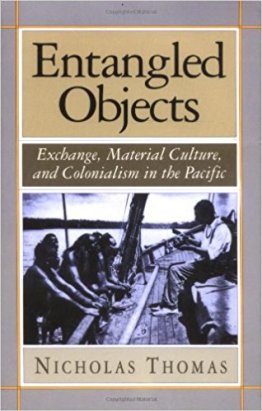
Nicholas Thomas, Entangled Objects: Exchange, Material Culture, and Colonialism in the Pacific (Cambridge: Harvard University Press, 1991)

Contrary to generations of anthropologists, Thomas wishes to paint “indigenous peoples as co-subjects in a wider system.”[1] The other-ing of Pacific islanders, an anthropological insistence on synthetic “us/them oppositions,” is best overcome by “pretending that there is a kind of symmetry between indigenous appropriation of European artifacts and the colonial collecting of indigenous goods.”[2] Approaching material culture in this way allows us to better appreciate the entanglement of objects, the diversity of meanings that characterize the exchange of goods among and between cultures.

Entangled objects are not reducible to “gifts” or “commodities” and neither are the systems that facilitate their movement. The inalienability of particular objects, the inability to commoditize certain goods, was prevalent throughout indigenous (and European) cultures, and Thomas argues that, often, complex social and cultural rituals surrounded objects that could not (or only partially) be reconceived as capital. Wedding rings, heirlooms, and regalia were not instantaneously reducible, and their propagation through a society was and is a process often independent from their material value. Contrarily, other objects have “exchange possibilities,” and play a part (not a universal one) in different types of transactions.[3] Thomas uses the Fijian origin-story of tabua (whale teeth) to demonstrate how human labor (a ubiquitous Marxist metric) was incommensurable with certain types of exchange, in this case one for wives. Value objects, like tabua, were thus appropriate for particular transactions and depending the type of object and the culture that possessed it, might be “valorizable” in comparison with other desirable things. Thomas suggests that Oceania was ripe with “systems which provided for the substitution of persons and things and those in which such equivalences [were] impossible.”[4]

This was the complex landscape into which European goods were introduced. Sailors had great difficulty in obtaining pigs from islanders for whom the animals were not valorized commodities, an entanglement which began to erode with the introduction of the trade of muskets. A spectrum of interactions and exchanges resulted from the convergence of two value-systems, and the mistake, according to Thomas, is to think of the introduction and adoption of new, Western goods was inevitable. “Western commodities cannot be seen to embody some irresistible attraction that is given the status of an inexorable historical force. Indigenous peoples’ interests in goods, strangers, and contact were variable and in some cases were extremely constrained.”[5] When objects were exchanged, Thomas insists that these encounters were “not merely a physical process but [was] also a movement and displacement of competing conceptions of things, a jostle of transaction forms.”[6] And the effects of this jostle were felt, as well, by the European curio collectors, adventurers, and “scientists” who populated Western museums with artifacts from the Oceanic world, reauthoring them in the process.

Mauss and Marx are ill-suited to the story of transcultural exchange outlined by Thomas. The transactions that played out in the South Pacific over the period of early contact are not reducible to a commodity market or a clash between pure “gift” and “commodity” systems. Europeans brought diverse and complicated object-associations to the table of Oceanic encounters and found there a network of entanglements no less complex than their own. Dynamic, promiscuous objects infiltrated the lives and worldviews of their new owners, leaving profound social consequences in their wake.

[1] Thomas, 14.

[2] Thomas, 5.

[3] Thomas, 73.

[4] Thomas, 77.

[5] Thomas, 103.

[6] Thomas, 123.

Reviews in the History of Stuff #3

Findlen’s collection is a seminal work in material culture studies, but since its publication, Pitelka has turned his article into a monograph published by the University of Hawaii Press. Once I get around to it, I’ll update this post.

51XvLkiTgYL._SX329_BO1,204,203,200_

Morgan Pitelka, “The Tokugawa Storehouse: Ieyasu’s Encounters with Things,” in Findlen, ed., Early Modern Things: Objects and Their Histories, 1500-1800 (Routledge, 2012)

As Walter Benjamin argued, the bricolage artifacts of modernity represent a “City of Mirrors,” one “that both brought people together as the crowd and permanently isolated them as bourgeois individuals,” Pitelka suggests the objects of Ieyasu Tokugawa’s storehouse are indicative of the cultural landscape of premodern Japan.[1] The shogun was a discriminating accumulator of things, object that “functioned not merely as markers of status or objects of fetishism, but as actors in networks of information and influence.”[2] Pitelka focuses on three possessions from Ieyasu’s catalog, each representative of a category of objects, each representative of an insight into the social landscape of Japan at the turn of the 17th century.

The arquebus first arrived in Japan in the hands of Portuguese traders in the year of Ieyasu’s birth, 1543. Its slow adoption into the conflict between feuding warlords proved useful in Ieyasu’s later bid for power. Japanese smiths constructed firearms according to the Portuguese model but developed them to meet their own requirements and utilize local materials. It was one of these guns, made by Noda Kiyotaka in 1611, which became a treasure of the Tokugawa.

And in the storehouse, alongside the cutting edge weapon technology of the 16th century, was prominently placed the cutting edge of a thousand years of Japanese warriors, a twelfth century short sword. This sword, named Ebina Kokaji, is representative for Pitelka of the thousands that were used as gifts between allies within feudal society. Giving swords (horses, women, rice, etc.) was a practice that cemented allegiances between rulers within a highly factionalized political environment. Thusly, Ieyasu, secured support of neighboring warlords during critical periods within his ascendancy.

Lastly, a Ming tea bowl serves to debunk certain long standing assertions regarding cultural exchange between China and Japan during the period. Not only did goods and ideas flow, but characteristics of Chinese (and Korean) culture were actively sought out by the young Ieyasu. Pitelka writes, “The Tokugawa storehouse thus contained material and visual culture from China, part of Ieyasu’s broad attempt to draw on what I have elsewhere called the institutional authority of Chinese civilization, but also an actual library of classic Chinese texts that became the foundation for shogunal policy and scholarship.”[3]

Ieyasu’s collection was crafted within an environment that influenced how he chose and valued his acquisitions. When he died, these items became part of a spiderweb of new discourses surrounding the meaning of things. Pitelka concludes, “The objects collected by Ieyasu over the course of his life and carefully distributed to his descendants and shrines after his death therefore continued to compel and shape the actions of Japan’s elites more than a century after he was buried.”[4] Objects, maybe not unlike their owners, undergo multiple reincarnations. Some are relegated to obscurity, valuelessness, and others are reconstructed in an attempt to navigate complex social and cultural landscapes.

[1] Pitelka, 297.
[2] Pitelka, 298. “Rather than seeing material culture as the product of a few exceptional historical subjects, or even as the result of a particular set of social or cultural conditions, we can integrate things into the overlapping collectives – the web of relations, performances, and practices – that make up history.”
[3] Pitelka, 310.
[4] Pitelka, 312.

Reviews in the History of Stuff #2

9780520244689

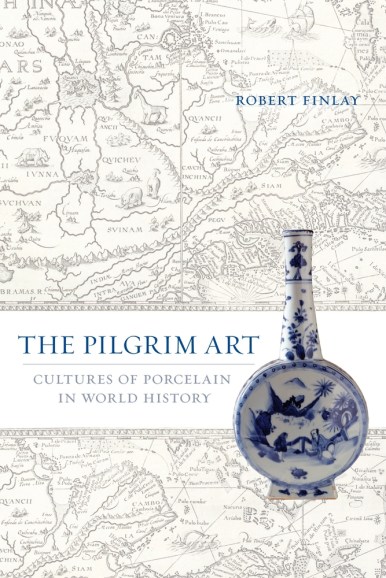
Robert Finlay, The Pilgrim Art: Cultures of Porcelain in World History (University of California, 2010)

Finlay writes, “Porcelain acted as a sensitive barometer of human affairs, more than any other commodity. It registered the impact of artistic conventions, international trade, industrial development, political turmoil, elite expenditure, ceremonial rites, and cultural contact.” These objects were and are vessels of cultural abstraction, embodying a visual language, “a koine of ceramic art.”[1] For Finlay, this is the explanatory power of those products of the pilgrim art. They reveal, in their form, decoration, and appreciation, “a cultural cynosure, a nexus where art and commerce converge, drawn together by an artifact that in some measure incarnates and articulates the beliefs, customs, and mentalities of those who make, purchase, and esteem it.”[2] Porcelain is the key to unlocking the cultural ecumene, the socio-cultural world that has imprinted itself on the ceramics it produced and left behind.

The character and secrets of porcelain manufacturing leaked westwards out of Jingdezhen, the porcelain city. And in the opposite direction moved the tastes of emerging world markets. Unlike the imperial furnaces that made wares exclusively for the imperial family in Beijing, the kilns of Jingdezhen developed a huge diversity of designs that were attuned to the desires of buyers in Manila, Delhi, Cairo, Paris, etc.. The speed and coordination with which these wares were produced “anticipates nicely Adam Smith’s celebrated description of the division of labor in the production of pins,” according to Finlay.[3] Meanwhile, Christian missionaries in Jingdezhen witnessed the conflation of porcelain firing with spiritual or magical significance: “Reproducing cosmic and alchemic processes, the kiln possesses the power to transubstantiate matter through employment of fire while the gods themselves act as celestial potters in shaping life form common clay.”[4]

Mercantilist anxieties mounted in the West, leading people like Dentrecolles to combine his efforts towards winning Christian converts with a frenzied campaign of industrial espionage,. Advisors to the heads of Europe stressed the need to bring Chinese technologies and production knowledge back to Europe lest the hemorrhagic flow of silver prove terminal to the self-assured, Christian powers. And while silk and cotton cloth manufacturing came with built-in biological and climatological obstacles, “porcelain represented the only significant Chinese product that Westerners could aspire to contest on their own grounds, not only producing imitations of it, but even making a near-equivalent with native materials.”[5] Thus, the “pilgrim art” was born in the kilns of Meissen and other manufacturies in France, England, and Holland. By 1700, many had cracked the secrets of porcelain, demythologizing it from alchemical mystery to the stuff of scientific analysis and industrial production.

The role and form of porcelain wares changed over the centuries and was firmly embedded in much longer and complex ceramic traditions across Eurasia. Designs were episodically adapted from antiquity and to changing tastes and behaviors, as with the flourishing of tea culture in east and west. Cultural exchange during the Song and Yuan dynasties generated a number of new forms and designs such as the famed Jingdezhen blue-and-white which emerged from commercial relationships that stretched from the porcelain city to Persia after 1320. Geography, fashion, performativity, and global market ideology all represented subtle influences on the shape, color, and character of the pottery pieces that were so precious in their time. Wedgewood’s and Meissen’s success were only a further episode in the long discourse between porcelain and the ecumene that gave it shape.

[1] Finlay, 6, 304.
[2] Finlay, 11.
[3] Finlay, 27.
[4] Finlay, 38.
[5] Finlay, 59.