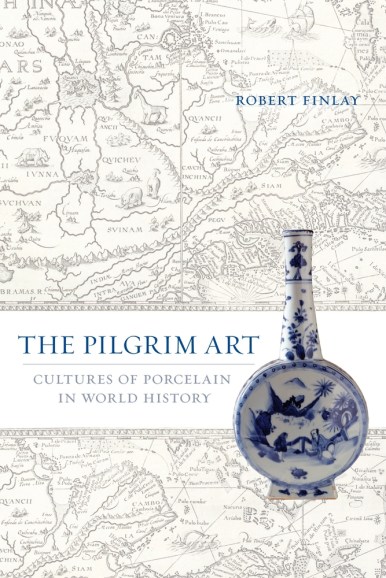
Robert Finlay, The Pilgrim Art: Cultures of Porcelain in World History (University of California, 2010)
Finlay writes, “Porcelain acted as a sensitive barometer of human affairs, more than any other commodity. It registered the impact of artistic conventions, international trade, industrial development, political turmoil, elite expenditure, ceremonial rites, and cultural contact.” These objects were and are vessels of cultural abstraction, embodying a visual language, “a koine of ceramic art.”[1] For Finlay, this is the explanatory power of those products of the pilgrim art. They reveal, in their form, decoration, and appreciation, “a cultural cynosure, a nexus where art and commerce converge, drawn together by an artifact that in some measure incarnates and articulates the beliefs, customs, and mentalities of those who make, purchase, and esteem it.”[2] Porcelain is the key to unlocking the cultural ecumene, the socio-cultural world that has imprinted itself on the ceramics it produced and left behind.
The character and secrets of porcelain manufacturing leaked westwards out of Jingdezhen, the porcelain city. And in the opposite direction moved the tastes of emerging world markets. Unlike the imperial furnaces that made wares exclusively for the imperial family in Beijing, the kilns of Jingdezhen developed a huge diversity of designs that were attuned to the desires of buyers in Manila, Delhi, Cairo, Paris, etc.. The speed and coordination with which these wares were produced “anticipates nicely Adam Smith’s celebrated description of the division of labor in the production of pins,” according to Finlay.[3] Meanwhile, Christian missionaries in Jingdezhen witnessed the conflation of porcelain firing with spiritual or magical significance: “Reproducing cosmic and alchemic processes, the kiln possesses the power to transubstantiate matter through employment of fire while the gods themselves act as celestial potters in shaping life form common clay.”[4]
Mercantilist anxieties mounted in the West, leading people like Dentrecolles to combine his efforts towards winning Christian converts with a frenzied campaign of industrial espionage,. Advisors to the heads of Europe stressed the need to bring Chinese technologies and production knowledge back to Europe lest the hemorrhagic flow of silver prove terminal to the self-assured, Christian powers. And while silk and cotton cloth manufacturing came with built-in biological and climatological obstacles, “porcelain represented the only significant Chinese product that Westerners could aspire to contest on their own grounds, not only producing imitations of it, but even making a near-equivalent with native materials.”[5] Thus, the “pilgrim art” was born in the kilns of Meissen and other manufacturies in France, England, and Holland. By 1700, many had cracked the secrets of porcelain, demythologizing it from alchemical mystery to the stuff of scientific analysis and industrial production.
The role and form of porcelain wares changed over the centuries and was firmly embedded in much longer and complex ceramic traditions across Eurasia. Designs were episodically adapted from antiquity and to changing tastes and behaviors, as with the flourishing of tea culture in east and west. Cultural exchange during the Song and Yuan dynasties generated a number of new forms and designs such as the famed Jingdezhen blue-and-white which emerged from commercial relationships that stretched from the porcelain city to Persia after 1320. Geography, fashion, performativity, and global market ideology all represented subtle influences on the shape, color, and character of the pottery pieces that were so precious in their time. Wedgewood’s and Meissen’s success were only a further episode in the long discourse between porcelain and the ecumene that gave it shape.
 Dystopamine