Thoughts on The Green Knight

The Green Knight Review: Dev Patel Stars in an Arthurian Masterpiece |  IndieWire
Dev Patel in The Green Knight, directed by David Lowery

Camus suggested that there was only one worthy question in all of philosophy – should one kill himself. In pondering this and in fleshing out his philosophy of the absurd he channels an ancient story, that of Sisyphus who is doomed by the gods to roll a boulder up a hill only to have it slip and return to rest at the bottom on the verge of his reaching the top. If Sisyphus, in Camus’ conception, believes that this time he will succeed in displacing the boulder, then he is damned. If he recognizes from the outset that his task is futile, then he is damned. This is the absurd predicament in which Camus suggests we all find ourselves – creatures desiring of meaning but finding our existence bereft of it, having been denied true purpose by gods or fate.

Here we find another ancient story, one that we might casually write off as being preoccupied with chivalric courage and the premodern creation of a cult of honor. That’s what my high school English teacher told me anyways. But in Lowery’s retelling of this medieval romance, we find something closer to Camus than to Mallory, or to Chaucer. Gawain is being pressured to grow up. By his mother. By his king. Youthful lust, a wandering spirit, and a lack of conviction keep him from assuming his seat at Arthur’s table. But forces from without, spells and admonitions, will compel Gawain to abandon his own preoccupations and pursue the only currency that matters in his world, honor.

Gawain believes that he is achieving some measure of honor when he accepts the Knight’s challenge. And again when he sets out on his quest. And again when he kneels, neck bared. The ambiguity of the film’s ending is whether or not he believes that it’s possible to get the stone to the top of the hill. Does he believe there is meaning in living an honorable life or is it a fiction that he must subscribe to? Should he let the axe fall?

Arthur is us, the audience. He prefers legends to truth. Before the Knight’s arrival he calls for “myths or cantos” as idle diversion. The round table and its knights have, in this telling, exerted honorable influence over the land, subjugating the Saxons and ravaging the countryside. This is Arthur’s acceptance of his purpose, stone and hill. Morgan/Morgause is a witch, fueled by patrimonial ambition. Winifred is a casualty of cruelty. The scavenger, an agent of it. This is the world from which Gawain has been sheltered and one he, in his quest, navigates in search of honor/purpose.

Now to the Green Knight. In dialogue I can’t recall faithfully, Alicia Vikander’s character explains the Knight and his relationship to the journey Gawain has undertaken. I paraphrase – green is what seeps in when red has faded. As we age, as our passions dull, as we compromise what it seems, in youth, natural to want in favor of those things that are determined for us to be worthy of our ardor, that is the Green Knight, coming to claim what is due.

Camus envisioned two versions of suicide. One – we let the axe fall and obliterate ourselves from a world that denies us something we so fervently desire. Two – we invent meaning where there is none. We go to church. We drink. We love simultaneously knowing and ignoring that oblivion awaits. That stone will just not reach the top. In the Owl Creek vignette, Gawain sees what accepting “honor” looks like. He becomes one of Arthur’s stories: powerful, tragic, and doomed like Arthur himself. On seeing this, he kneels before the Green Knight, ready to die, something the Green Knight either denies him or obliges. What the myth reveals is that it does not matter.

I think this is a film about being seduced by worlds: that of mothers, kings, spirits. Our paths are invariably ones from blue and yellow, when we exist as untested knights, towards the green, the natural diluting and blending of our nascent selves into shapes the world can comprehend and use. And red is absent entirely. It can only ever be the stuff of dream and fantasy as we await our end, all paths converging under the axe of the Green Knight.

Why House on Haunted Hill (1999) is worth watching.

I’ve spent considerable oxygen defending this film’s creature effects, its shlocky acting, and its oddly paced, tensionless plot. This post will not attempt to expand on these elements but instead, aims to suggest that William Malone’s “remake” of a 1959 William Castle film occupies an important, or at least an interesting place in horror history.

Some here will be intimately familiar with William Castle, but for those who aren’t – as a tween, he goaded Bela Lugosi into giving him a manager position with the Dracula stage play. A few years later, he leased a theater from Orson Welles and painted swastikas all over it to create a buzz around a play he had written in a weekend. As a filmmaker he is known as the master of the gimmick. Tickets to his first independently produced feature, Macabre (1958) came with $1000 life insurance policies in case audience members died of fright. Most famously, he sent crews to install vibrating motors in theater seats for his 1959 film, The Tingler. Castle would go on to direct over fifty features (and produce several dozen more) and is cited as a huge source of inspiration for filmmakers from Hitchcock to Zemeckis. For more on Castle see his memoir Step Right Up! I’m Gonna Scare the Pants Off America or the 2007 documentary, Spine Tingler! The William Castle Story, directed by Jeffrey Schwartz.

1959’s House on Haunted Hill stars Vincent Price as a wealthy kook offering $10,000 to any party guests who can survive an overnight haunted house party held in his wife’s honor. SPOILERS. It’s all a ruse to bring an end to a fractious marriage. Price uses some combination of traps and puppets to see his wife dispatched in a vat of acid. It’s worth a watch if only to see Price chew the admittedly cheap scenery (https://www.youtube.com/watch?v=T9RedbhV8Pc). Castle strung plastic skeletons from theater ceilings to swoop around during screenings. Fast forward a half-century….

In 1999, Dark Castle Entertainment was formed by Joel Silver and Robert Zemeckis. William Castle’s daughter, Terry, would serve as co-producer of their first feature, a loose remake of her father’s House on Haunted Hill. The cast stands as a perfect capstone of 1990s B-filmmaking: Corky Romano, Final Destination Girl, Sonya Blade, Xenia Onatopp, that guy who helped Stella get her groove back, and Geoffrey Rush, whose Vincent Price reprise brings an involuntary smile to my face. The house itself is a testament to brilliant matte painting and, incidentally, is no longer a house. The Vannacutt Psychiatric Institute for the Criminally Insane is the setting for the night’s festivities and the prize for surviving has been upped to a cool million. A NYT reviewer suggested Alan Greenspan should look to this as a clear instance of “inflation aborning.”

Atop a matrimonial murder plot this go around are plenty of ghosts, echoes of the Art Deco era crimes committed by the psychopathic Dr. Richard Vannacutt, played by Jeffrey Combs. Creature effects and design were done by KNB, with support from Dick Smith (in his last film credit). If for no other reason, see the film to see one of Smith’s old, unused monster designs from the golden age of practical effects (or spoil it here – https://www.youtube.com/watch?v=nI7w-5S2rrA). Some creepy stop-motion and some cloggy CGI would make the film’s crescendo truly harrowing if it had bothered to give us any characters to root for, but regardless, it was a fun, spooky romp when it was released in October of 1999. And in William Castle fashion, select theaters handed out scratch cards with a chance to win a cash prize, presumably if you survived the film.

So why bother with this movie? House on Haunted Hill (1999) had enough of a return to fuel a second remake, Thirteen Ghosts (2001) which occupies a soft spot in many hearts. Dark Castle Entertainment would shortly thereafter abandon Castle reboots and instead produce/distribute a number of quirky, imperfect horror films, Ghost Ship (2002), Gothika (2003), The Reaping (2007), Orphan (2009), Splice (2009), before being absorbed into Universal. In an era when remakes are unapologetic about their cash grabbiness, House on Haunted Hill represents something different. Evidencing this, is Jeffrey Combs.

I just watched Combs in a vignette from Shudder’s Creepshow and I, for one, am grateful that he always seems to be waiting in the wings when a new love letter to horror is penned. And that is what this film is. Geoffrey Rush’s character is another example of the rich, internal language of horror. He is simultaneously channeling Vincent Price and William Castle himself – a devious huckster whose disbelief and cynicism erode as real terror rises to the surface. The film has its flaws, but here, twenty years later (sixty out from the original), I think it rewards those who view it less as a bricolage of all that was bad in 90s horror and more as a film by and for fans of the genre. Many of William Castle’s films do not hold up, but House on Haunted Hill (1999) offers a way to experience that legacy, plastic skeletons, seat tinglers, and all.

Reviews in the History of Stuff #4

51iqBpPWXEL._SX316_BO1,204,203,200_

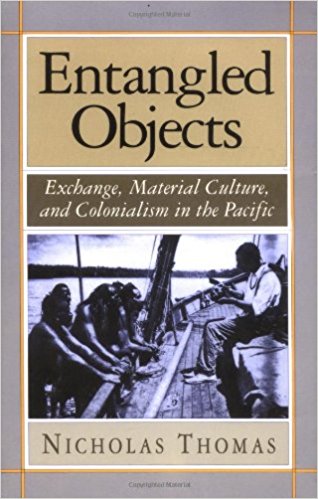
Nicholas Thomas, Entangled Objects: Exchange, Material Culture, and Colonialism in the Pacific (Cambridge: Harvard University Press, 1991)

Contrary to generations of anthropologists, Thomas wishes to paint “indigenous peoples as co-subjects in a wider system.”[1] The other-ing of Pacific islanders, an anthropological insistence on synthetic “us/them oppositions,” is best overcome by “pretending that there is a kind of symmetry between indigenous appropriation of European artifacts and the colonial collecting of indigenous goods.”[2] Approaching material culture in this way allows us to better appreciate the entanglement of objects, the diversity of meanings that characterize the exchange of goods among and between cultures.

Entangled objects are not reducible to “gifts” or “commodities” and neither are the systems that facilitate their movement. The inalienability of particular objects, the inability to commoditize certain goods, was prevalent throughout indigenous (and European) cultures, and Thomas argues that, often, complex social and cultural rituals surrounded objects that could not (or only partially) be reconceived as capital. Wedding rings, heirlooms, and regalia were not instantaneously reducible, and their propagation through a society was and is a process often independent from their material value. Contrarily, other objects have “exchange possibilities,” and play a part (not a universal one) in different types of transactions.[3] Thomas uses the Fijian origin-story of tabua (whale teeth) to demonstrate how human labor (a ubiquitous Marxist metric) was incommensurable with certain types of exchange, in this case one for wives. Value objects, like tabua, were thus appropriate for particular transactions and depending the type of object and the culture that possessed it, might be “valorizable” in comparison with other desirable things. Thomas suggests that Oceania was ripe with “systems which provided for the substitution of persons and things and those in which such equivalences [were] impossible.”[4]

This was the complex landscape into which European goods were introduced. Sailors had great difficulty in obtaining pigs from islanders for whom the animals were not valorized commodities, an entanglement which began to erode with the introduction of the trade of muskets. A spectrum of interactions and exchanges resulted from the convergence of two value-systems, and the mistake, according to Thomas, is to think of the introduction and adoption of new, Western goods was inevitable. “Western commodities cannot be seen to embody some irresistible attraction that is given the status of an inexorable historical force. Indigenous peoples’ interests in goods, strangers, and contact were variable and in some cases were extremely constrained.”[5] When objects were exchanged, Thomas insists that these encounters were “not merely a physical process but [was] also a movement and displacement of competing conceptions of things, a jostle of transaction forms.”[6] And the effects of this jostle were felt, as well, by the European curio collectors, adventurers, and “scientists” who populated Western museums with artifacts from the Oceanic world, reauthoring them in the process.

Mauss and Marx are ill-suited to the story of transcultural exchange outlined by Thomas. The transactions that played out in the South Pacific over the period of early contact are not reducible to a commodity market or a clash between pure “gift” and “commodity” systems. Europeans brought diverse and complicated object-associations to the table of Oceanic encounters and found there a network of entanglements no less complex than their own. Dynamic, promiscuous objects infiltrated the lives and worldviews of their new owners, leaving profound social consequences in their wake.

[1] Thomas, 14.

[2] Thomas, 5.

[3] Thomas, 73.

[4] Thomas, 77.

[5] Thomas, 103.

[6] Thomas, 123.

Reviews in the History of Stuff #3

Findlen’s collection is a seminal work in material culture studies, but since its publication, Pitelka has turned his article into a monograph published by the University of Hawaii Press. Once I get around to it, I’ll update this post.

51XvLkiTgYL._SX329_BO1,204,203,200_

Morgan Pitelka, “The Tokugawa Storehouse: Ieyasu’s Encounters with Things,” in Findlen, ed., Early Modern Things: Objects and Their Histories, 1500-1800 (Routledge, 2012)

As Walter Benjamin argued, the bricolage artifacts of modernity represent a “City of Mirrors,” one “that both brought people together as the crowd and permanently isolated them as bourgeois individuals,” Pitelka suggests the objects of Ieyasu Tokugawa’s storehouse are indicative of the cultural landscape of premodern Japan.[1] The shogun was a discriminating accumulator of things, object that “functioned not merely as markers of status or objects of fetishism, but as actors in networks of information and influence.”[2] Pitelka focuses on three possessions from Ieyasu’s catalog, each representative of a category of objects, each representative of an insight into the social landscape of Japan at the turn of the 17th century.

The arquebus first arrived in Japan in the hands of Portuguese traders in the year of Ieyasu’s birth, 1543. Its slow adoption into the conflict between feuding warlords proved useful in Ieyasu’s later bid for power. Japanese smiths constructed firearms according to the Portuguese model but developed them to meet their own requirements and utilize local materials. It was one of these guns, made by Noda Kiyotaka in 1611, which became a treasure of the Tokugawa.

And in the storehouse, alongside the cutting edge weapon technology of the 16th century, was prominently placed the cutting edge of a thousand years of Japanese warriors, a twelfth century short sword. This sword, named Ebina Kokaji, is representative for Pitelka of the thousands that were used as gifts between allies within feudal society. Giving swords (horses, women, rice, etc.) was a practice that cemented allegiances between rulers within a highly factionalized political environment. Thusly, Ieyasu, secured support of neighboring warlords during critical periods within his ascendancy.

Lastly, a Ming tea bowl serves to debunk certain long standing assertions regarding cultural exchange between China and Japan during the period. Not only did goods and ideas flow, but characteristics of Chinese (and Korean) culture were actively sought out by the young Ieyasu. Pitelka writes, “The Tokugawa storehouse thus contained material and visual culture from China, part of Ieyasu’s broad attempt to draw on what I have elsewhere called the institutional authority of Chinese civilization, but also an actual library of classic Chinese texts that became the foundation for shogunal policy and scholarship.”[3]

Ieyasu’s collection was crafted within an environment that influenced how he chose and valued his acquisitions. When he died, these items became part of a spiderweb of new discourses surrounding the meaning of things. Pitelka concludes, “The objects collected by Ieyasu over the course of his life and carefully distributed to his descendants and shrines after his death therefore continued to compel and shape the actions of Japan’s elites more than a century after he was buried.”[4] Objects, maybe not unlike their owners, undergo multiple reincarnations. Some are relegated to obscurity, valuelessness, and others are reconstructed in an attempt to navigate complex social and cultural landscapes.

[1] Pitelka, 297.
[2] Pitelka, 298. “Rather than seeing material culture as the product of a few exceptional historical subjects, or even as the result of a particular set of social or cultural conditions, we can integrate things into the overlapping collectives – the web of relations, performances, and practices – that make up history.”
[3] Pitelka, 310.
[4] Pitelka, 312.

Reviews in the History of Stuff #2

9780520244689

Robert Finlay, The Pilgrim Art: Cultures of Porcelain in World History (University of California, 2010)

Finlay writes, “Porcelain acted as a sensitive barometer of human affairs, more than any other commodity. It registered the impact of artistic conventions, international trade, industrial development, political turmoil, elite expenditure, ceremonial rites, and cultural contact.” These objects were and are vessels of cultural abstraction, embodying a visual language, “a koine of ceramic art.”[1] For Finlay, this is the explanatory power of those products of the pilgrim art. They reveal, in their form, decoration, and appreciation, “a cultural cynosure, a nexus where art and commerce converge, drawn together by an artifact that in some measure incarnates and articulates the beliefs, customs, and mentalities of those who make, purchase, and esteem it.”[2] Porcelain is the key to unlocking the cultural ecumene, the socio-cultural world that has imprinted itself on the ceramics it produced and left behind.

The character and secrets of porcelain manufacturing leaked westwards out of Jingdezhen, the porcelain city. And in the opposite direction moved the tastes of emerging world markets. Unlike the imperial furnaces that made wares exclusively for the imperial family in Beijing, the kilns of Jingdezhen developed a huge diversity of designs that were attuned to the desires of buyers in Manila, Delhi, Cairo, Paris, etc.. The speed and coordination with which these wares were produced “anticipates nicely Adam Smith’s celebrated description of the division of labor in the production of pins,” according to Finlay.[3] Meanwhile, Christian missionaries in Jingdezhen witnessed the conflation of porcelain firing with spiritual or magical significance: “Reproducing cosmic and alchemic processes, the kiln possesses the power to transubstantiate matter through employment of fire while the gods themselves act as celestial potters in shaping life form common clay.”[4]

Mercantilist anxieties mounted in the West, leading people like Dentrecolles to combine his efforts towards winning Christian converts with a frenzied campaign of industrial espionage,. Advisors to the heads of Europe stressed the need to bring Chinese technologies and production knowledge back to Europe lest the hemorrhagic flow of silver prove terminal to the self-assured, Christian powers. And while silk and cotton cloth manufacturing came with built-in biological and climatological obstacles, “porcelain represented the only significant Chinese product that Westerners could aspire to contest on their own grounds, not only producing imitations of it, but even making a near-equivalent with native materials.”[5] Thus, the “pilgrim art” was born in the kilns of Meissen and other manufacturies in France, England, and Holland. By 1700, many had cracked the secrets of porcelain, demythologizing it from alchemical mystery to the stuff of scientific analysis and industrial production.

The role and form of porcelain wares changed over the centuries and was firmly embedded in much longer and complex ceramic traditions across Eurasia. Designs were episodically adapted from antiquity and to changing tastes and behaviors, as with the flourishing of tea culture in east and west. Cultural exchange during the Song and Yuan dynasties generated a number of new forms and designs such as the famed Jingdezhen blue-and-white which emerged from commercial relationships that stretched from the porcelain city to Persia after 1320. Geography, fashion, performativity, and global market ideology all represented subtle influences on the shape, color, and character of the pottery pieces that were so precious in their time. Wedgewood’s and Meissen’s success were only a further episode in the long discourse between porcelain and the ecumene that gave it shape.

[1] Finlay, 6, 304.
[2] Finlay, 11.
[3] Finlay, 27.
[4] Finlay, 38.
[5] Finlay, 59.

Monster Movies and the History of Shopping

I lectured this week on the history of retail and the origins of consumer culture. In my talk, I used several clips from some of my favorite scary movies (artifacts of having written and delivered a similar lecture last Halloween). I thought I’d share links to those clips here and discuss how they can serve as waypoints in telling the story of how we became a society of shoppers.

Picture3

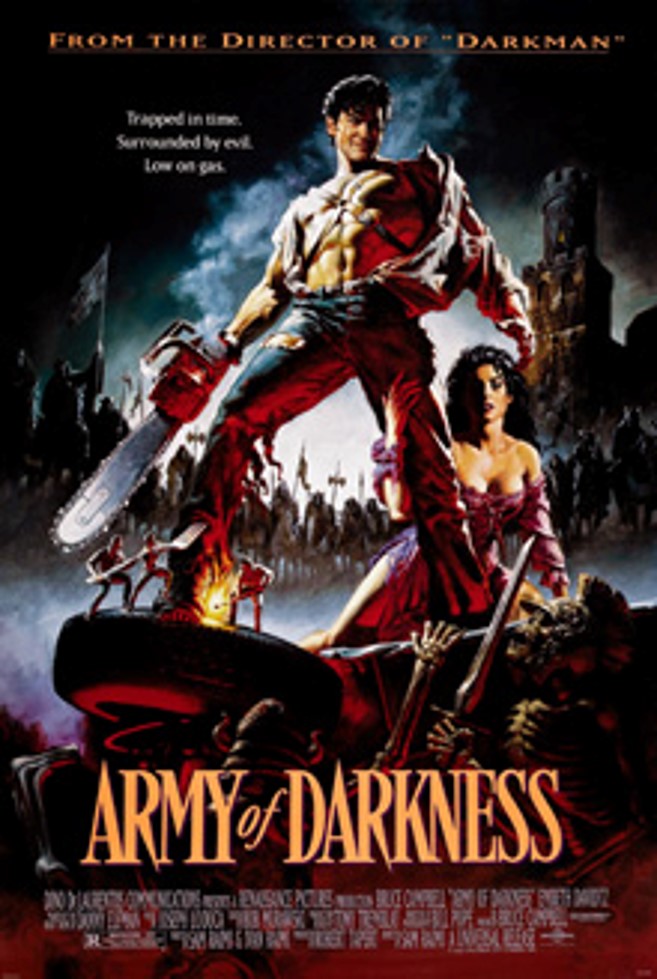
“Shop smart! Shop S-Mart!” – Army of Darkness (1992), dir. Sam Raimi (https://www.youtube.com/watch?v=pFriRcIwqNU)

The historian Patricia Crone writes, “To think away modern industry is to think away an enormous amount of wealth. [….] Preindustrial societies were dominated by scarcity.” Ordinary people during the European Middle Ages weren’t consumers as we understand the term. There just wasn’t enough stuff. I tell my students that they carry around on their person more manufactured objects (stuff made by others for the express purpose of being sold) than most pre-industrials would have encountered in their lifetimes. The production of meager goods took place in the home, but more importantly, the lack of a network by which goods moved and were exchanged meant that medieval peasants lacked the ideological and linguistic equipment to understand markets. The closest we get in the centuries between the fall of Rome and the Italian Renaissance were the trade fairs, held periodically in towns and cities, but even these were still largely fixtures in a barter economy and were not indicative of widespread specialization in craft manufacturing. These marketplaces are the arenas in which career merchants begin to amass wealth and wield greater influence, which in both the West (feudalism) and the East (Confucian social classes) disrupts existing socio-political institutions.

The word “retail” comes from the French, retailler, which means to parse or cut off. Medieval merchants moved small quantities of trade goods from town to town, and as trade networks between continents and cultures expanded, so too did the range of goods offered by merchants in urban marketplaces. New products flowed along the Silk Road and maritime trade routes: porcelain, silk, spices, tobacco, mahogany, coffee, tea, sugar, chocolate.

Picture2

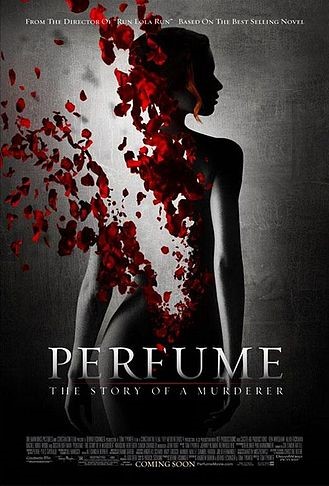
The Early Modern Parisian Market – Perfume: The Story of A Murderer (2006), dir. Tom Tykwer (https://www.youtube.com/watch?v=mJagO4ZtZK0)

The murderer Jean Baptiste Grenouille encounters the range of smells in a market in pre-revolutionary Paris (sorry for crummy quality). The possibility of choice led to a sport of choosiness, and this was particularly true in Bourbon France, an empire centered around fashionable consumption.

Ultimately, industrialization made possible the full flowering of consumer behavior in the West. A river of diverse, affordable goods flowed out of new factories, enabling members of every social class to aspire to self-expression through the stuff they bought. Branding and mass marketing acknowledged a phenomenon that had matured over the preceding century – people found meaning, crafted personal identity alongside their things. Department stores and mail order catalogs in the late 19th century offered everything from dry goods to sex toys, and simultaneously trumpeted the utopian vision of a plentiful, industrial future. They were marble temples, with electric lights and escalators, to the material potential of humankind and our eerily worshipful behavior persists.

Picture1

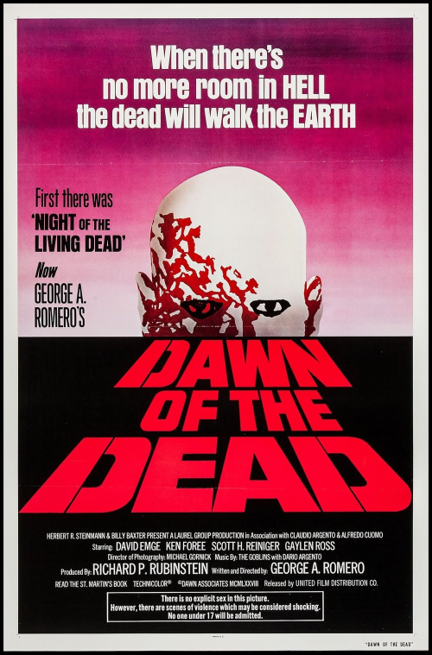
“They’re us.” – Dawn of the Dead (1978), dir. George Romero        (https://www.youtube.com/watch?v=dyucU5rtIu8)

In an interview, George Romero recounted a trip to a new shopping mall in Monroeville, PA in the early 70s. He noted the network of hallways and hidden corridors and the flat, numb expression that seemed the norm among mall shoppers. Our mindless, shallow materialism may be one of the less catastrophic consequences of the industrial-consumption complex (when compared to environmental degradation and the corporate enslavement of sweat shop nations), but it remains unsettling. It’s tough to imagine a time when the pursuit of material goods was not a structural influence on the ways we lead our lives. It’s important to remind ourselves that the overwhelming desire to express ourselves through consuming is a side effect of the end of scarcity. The past shows us that for most people, for most of human history, this was not the case.

There Is No Escape #5

pocketwatch_th001.jpga4b47427-8c3a-45e7-80ba-aec5cbb1e906LargerReginald Bryce was a precocious boy who, at the age of ten, thought he saw a young girl disappear down a rabbit hole in Cheshire. He had been walking along a riverbank on Sunday after church when he was drawn to a voice calling “But wait, Mr. Rabbit.” Reg began to jog through the undergrowth, emerging into a clearing just as a pair of stockings disappeared into the roots of a sprawling willow. He shouted as he ran over, tripping on a clump of weeds and tearing his breeches at the knee. There were no stockings, no girl, and no Mr. Rabbit to be seen so Reg, shaken, limped home. His mother had been sitting at the drawing room window when he came in. He told her about the girl on the riverbank and she tightened her grip on her needlepoint. Thoughts raced through her head of the sanitarium in Oxford or sending Reg to Sumatra with the merchant marine. Instead she whipped him for tearing his trousers and there was no more talk of girls or rabbits. Reginald was apprenticed to a shopkeeper a few years later and married a girl from Aylesbury a few years after that. They had three daughters, Mary, Margaret, and Carol. Carol died of scarlet fever when she was three. Reg bought a share in a grain mill. Once, they took the train to Brighton on holiday. One day, while out walking, Reg fell into the River Higham and drowned. He was seventy-one.

There Is No Escape #4

FA-A55436-2John and Mary Bishop left London by train in the spring of 1940 to stay with an old widow in the country. John had just turned thirteen and his sister, who cried the entire trip, was nine. The platform had been full of tearful mothers, but Alice Bishop was not a sentimental woman. She handed her teenage son a roll of pound notes and shook Alice by the shoulders and told her through gritted teeth to “stop yer bawlin.’” She didn’t wave. The pair shared a compartment with four other children, two boys and two girls, who politely ignored Mary’s sobbing. The oldest brother, a few years older than John, stared out the window, rising a little in his seat as they passed a muster of soldiers on one of the platforms. “Our dad’s in France,” said the youngest of the girls sitting across from John and Mary. “Where’s yours?” John just shrugged and Mary began crying harder. John fought back tears himself, unwilling, like his mother, to let the others see him cry.
The six children disembarked at the same platform, a rickety, sunbaked wooden structure surrounded by trees and a muddy cart path. The widow arrived for the Bishops. She was not as old as John had suspected, but much fatter. She was walking, with a basket on one arm, and after a terse greeting, gestured to the two of them to fall in behind. The young girl from the train waved at John as he looked back at the four children, alone on the platform. The widow proved nice enough. She would save up her sugar and butter rations and then let Mary choose from a battered old cookbook what they would bake for Sunday tea. Her little farmhouse was warm and no bombs fell there. She even had a typewriter, where John plunked out transcripts of the wireless reports in the evenings. The widow’s favorite topic of conversation was her eccentric neighbor, a professor of antiquities who, she claimed, had a vast collection of sinister artifacts. She once told the children that her husband had helped him collect a large parcel from the train platform. The professor claimed it contained a magical wardrobe. “Nuts, I say,” she’d exhale. John enlisted at eighteen when the war was winding down. He spent his enlistment sitting in an office in Southampton typing up discharges for returning soldiers. After the war, he worked in a canning factory, but fell to drinking. He committed suicide in 1959. Mary got very into the sixties. Later she moved to Majorca and opened a dog grooming studio.

There Is No Escape #3

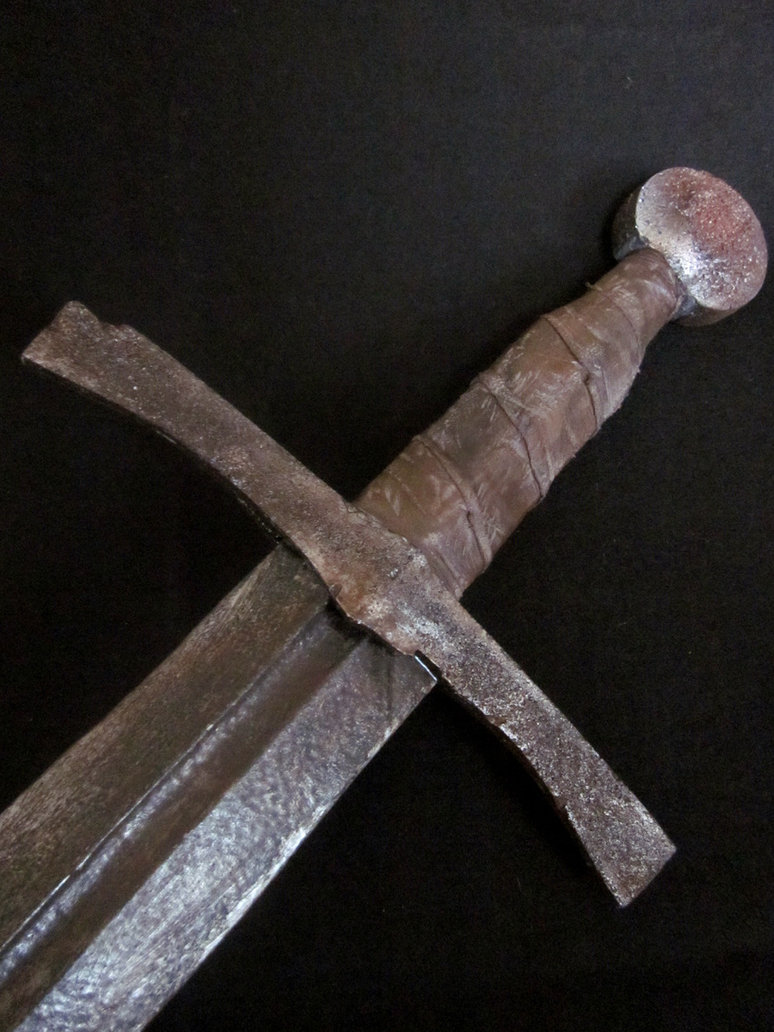
rusty_larp_sword_by_bloodworxsander-d5x9f80Thomas Tanner lived south of the river in a thatched house with his parents, grandparents, and seven siblings. Tom was the middle child and had just begun helping his father in the vats, dredging goat and cow hides though the solution of salt and potash. His father told him that his hands would soon turn “tanner’s black,” which scared the eight-year-old who already hated the foul smells that clung to him and the burning that lingered in his nose and eyes after the day’s work was done. The priests had commanded that all workshops were to be closed the day of the tournament. Thomas, his father, and his older brother, Peter, who had lost a hand to gangrene after piercing it on a farrier’s nail on the riverbank, went to watch the joust. The crowd pushed and pulled at the small, stinking boy and eventually, Thomas found himself alone, wandering the alleys on the north side of the cathedral. He tried to make his way toward the jubilant cries of the crowd, but the narrow alleys echoed and channeled the sound so that the shouts seemed to be coming from everywhere at once. Eventually, he emerged into the deserted square in front of the church. He watched as a tow-headed boy, a few years older than himself, emerged from the alley opposite and headed towards him. Tom lingered in the shadows, and the boy streaked across the cobblestones towards the gleaming hilt of a sword, standing upright in a stone in the center of the square. The blond boy reached the stone and in one swift motion pulled the sword from it before taking off at a run, back in the direction from which he’d come. Tom continued to wander the streets aimlessly. He found the river sometime after dark and made his way back to his house. It was dark when he arrived. His family had gone to sleep. He never told them about what he saw though there was a good deal of bell ringing and cheering from the far side of the river the next morning. Tom overheard chatter about swords and kings that day around the vats, but he began feeling poorly around noon. His brother led him to a pile of raw goat hides and laid him down on top. His father carried him home at dusk where he died three days later from fever.

Reviews in the History of Stuff #1

David Hancock, Oceans of Wine: Madeira and the Emergence of American Trade and Taste (Yale, 2009)

Hancock, by telling wine stories, hopes to approach a coherent theory of production, distribution, and consumption. Madeira flowed throughout the Atlantic world and beyond, and its trip from vineyard to table represented a system of networked individuals and institutions. This “wine complex” illustrates the influence and accessibility of commodities in a new, globalizing economy and undermines old assertions that the early modern period was one of rigid, competing empires. Hancock writes, “The boundaries of empire were extremely permeable, and drinkers made the most of the situation.”[1]

During, the period between 1640 (when the Portuguese regained sovereignty from the Spanish Hapsburgs) and 1815, the island of Madeira was a wealthy, cosmopolitan port within the Atlantic triangle. Early experiments with sugar cultivation were quickly overrun by viticulture, a new and profitable industry that forged commercial connections between the island’s Portuguese natives and its controversial foreigners (largely Britons). Ties to “importers, sellers, and drinkers in London, Lisbon, Bahia, and Philadelphia” placed Madeira at the center of a network, one throughout which wine and information moved at the speed of sail. On the island itself, farmers served as intermediaries between wealthy landowners and tenant vintners. These actor-groups, over the course of the 18th century, experimented with a number of grape varieties with a high degree of attunement to the tastes of foreign markets. Rising prices brought entrepreneurial interlopers into the wine network (supplanting the farmers) and “by the turn of the 19th century, producers and distributors together had transformed Madeira into a complex, highly processed, expensive, and status-laden beverage.”[2]

When an independent American market reopened after the Revolution, a stockpile of Madeira was waiting. Distributors not only capitalized off the demands of a country that had been too long without refreshing diversion; they also created strata of consumption. Color, flavor, dryness, age, booziness – all discursively influenced the production and consumption of wine across the Atlantic world. People and purses of influence demanded wine that met particular criteria and, thus, Madeira was bound up in circles of fashionability and emulation. Even its packaging evolved to elicit consumer preference. Anglophone North America forged a special alliance with the island, receiving the bulk of wine shipments and its inhabitants consumed more Madeira than any other variety by the early-18th century.[3] It became the target of boycotts during the early years of the Revolution in response to prohibitive British duties and later to Portuguese trade restrictions. In terms of volume, imports never recovered after independence, while simultaneously, Madeira trade flourished in British India and Asia. Regardless, Madeira would remain “American’s wine” and American’s would comprise the most robust customer-networks that conspired with producers in the making of Madeira. A capitalist, transimperial economy emerged. Hancock writes, “there was too much to be gained by regularity and consistency, by ongoing relationships with suppliers and customers, by the carefully maintained networks.”[4] American wholesalers and merchants dispersed Madeira throughout the colonies and west. The wine complex extended the entire length of the Atlantic seaboard, throughout the Caribbean, into Canada, and west to the frontier taverns and trading posts of the Ohio River Valley. Amidst grocers and shopkeepers, specialized wine retailer arose, cultivating their own marketing techniques to appeal to the customer-complexes that sustained the trade.

Hancock does not hesitate to place Madeira in the heart of a consumer revolution in America. Additionally, he argues that while drinking constituted participation in a vibrant pub-lic sphere, it was chiefly consumed in the home. These spaces and the practices and accessories associated with alcohol consumption “reconnected people’s behaviors and ideas to the production, distribution, and use of goods in their lives.”[5] Women, blacks, and Native Americans developed their own (or were prescribed by white men) certain associations with drink and were, therefore, “nodes of the network.” Predominantly, Madeira was conscripted into fashionable performance, a scene in which “possessions alone were insufficient to denote quality, rather, consumers had to know how to perform with them; how to talk about them, use them, and conduct themselves with them.”[6] Toasts represented a language of taste. Cellars were ripe with their own codes of connoisseurship. Other props (labels, decanters, corkscrews) represented the revealed world of fashionable consumption and were part of Madeira’s expanding role in an emerging consumer society.

Summarily, Hancock’s work is a bit dry at times (pale in color, notes of chestnut and unripe pear). That said, its value lies in highlighting the importance of distributors in a world of Atlantic exchange. Between makers and users exists an intricate complex of productive middlemen, without whom the flow of goods and the revolutions consumer activities engendered would never have been possible.

[1] Hancock, xv. Network here bears the mark of Latour and Callon.
[2] Hancock, 73. A comprehensive chronicle of wine making techniques and practices follows in Chapters 3 and 4. Of particular interest here are descriptions of how winemakers, anxious to capitalize off of a particularly marketable color or degree of sweetness, adulterated wine mixtures with everything from animal blood (used in clarification) to lead.
[3] Hancock, 114-5.
[4] Hancock, 198.
[5] Hancock, 278.
[6] Hancock, 335.